Music / The country it runs through
An instrument with an African lineage
The banjo reached the mountains through African American musicians, and the clawhammer style played here is part of that transmission.
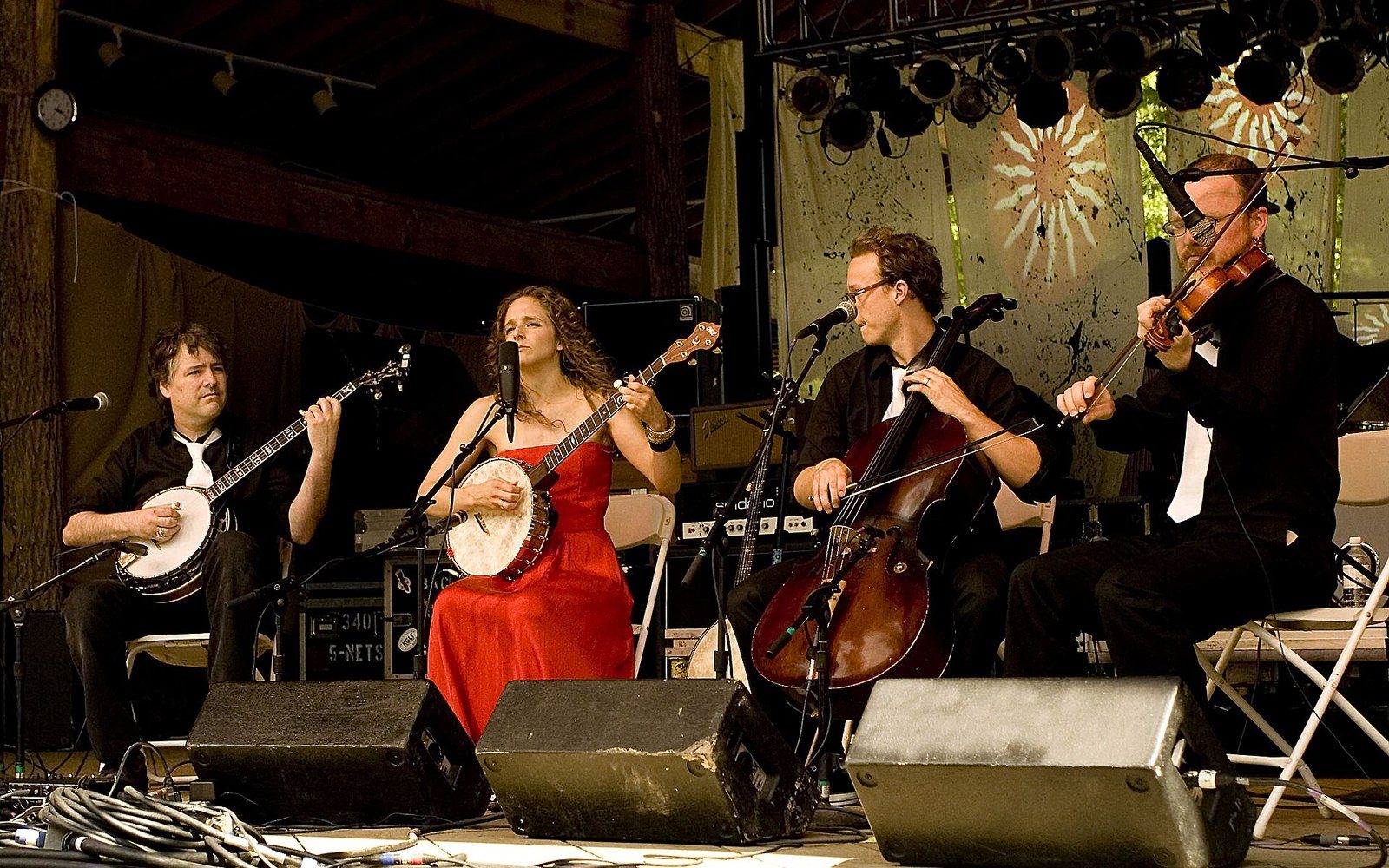
A banjo on stage. The clawhammer technique played in these mountains descends from African American practice.
Photo: Sparrowquartet · Wikimedia CommonsThe banjo did not begin in the mountains
The sound most associated with the Blue Ridge — that hollow, percussive knock of strings against a drum head — did not originate there. The banjo arrived in Appalachia through a long transmission that began in West Africa, crossed the Atlantic in the worst possible circumstances, and entered the mountain repertoire through contact between Black and white musicians in the plantation South. The instrument that visitors hear at the Blue Ridge Music Center near milepost 213 carries that entire history in its construction.
African instruments using a skin membrane stretched over a gourd body and fitted with a long neck were documented in the Caribbean and the American South from the seventeenth century onward. The enslaved people who built them were drawing on traditions from Senegambia and the broader West African coast, where similar instruments — the akonting of the Jola people being one of the most closely studied — used a floating thumbstick and a downward-striking stroke that produces the rhythmic thump recognizable in clawhammer playing today. The structural logic of those instruments and the stroke used to play them are the direct ancestors of what was later called old-time style, frailing, or clawhammer.
The name akonting and the instrument itself were brought to wider scholarly attention through the work of ethnomusicologists, and the connection between it and the American banjo's playing technique is documented in comparative musicology research ↗ that has shifted how historians understand the instrument's origins. For most of the twentieth century the banjo was presented as quintessentially Appalachian — an emblem of mountain isolation. The research of the last four decades has dismantled that story at the root.
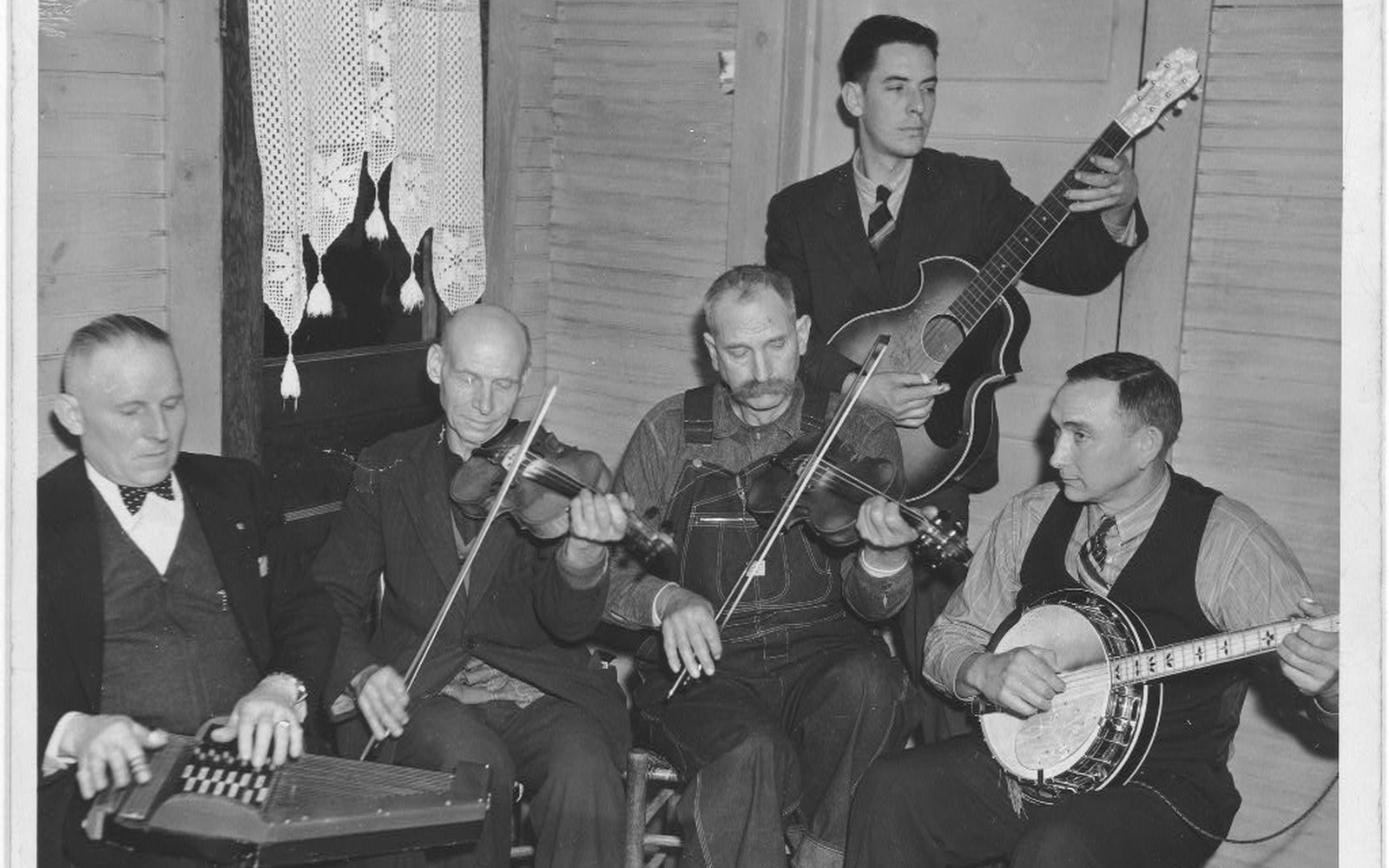
A Virginia string band in 1937. Zither, two fiddles, guitar and banjo — the instrumentation collectors kept finding.
Photo: Virginia-stringband-1937 · Wikimedia CommonsHow the stroke survived
Clawhammer is not a guitar technique applied to a banjo. It is a different physical logic. The back of the nail strikes down across the strings, and the thumb catches the fifth string — the drone string, short and mounted high on the neck — on the offbeat. The result is a melody note, a brush, and a thumb note in a rolling pattern that locks together with percussion. The right hand never plucks upward in the standard sense; it falls, it catches, it falls again. Players who learn it describe the difficulty not as complexity but as the effort of unlearning the instinct to pull.
That downward-striking motion is the critical link. Scholars including Shlomo Pestcoe and Greg C. Adams, writing on banjo organology and African instrument traditions ↗, have traced the downstroke pattern through African diasporic music in the Caribbean and the antebellum South, arguing that the technique entered Appalachian tradition through sustained, everyday musical exchange — musicians learning from each other across the rigid social lines of the plantation era. It was not a clean handover, and the timeline is not tidy, but the direction of travel is clear enough: the stroke came from African musicians and it stayed.
The five-string banjo as a manufactured instrument was popularized in the 1840s and 1850s partly through minstrelsy — a history that is neither incidental nor something the instrument can be separated from — but the clawhammer technique predates the commercial instrument and persisted in rural Black and white communities well after the parlor banjo craze of the late nineteenth century had moved on to different styles. By the time field recordings began to document southern Appalachian music in the early twentieth century, clawhammer was already being described as old, which is itself a kind of evidence.
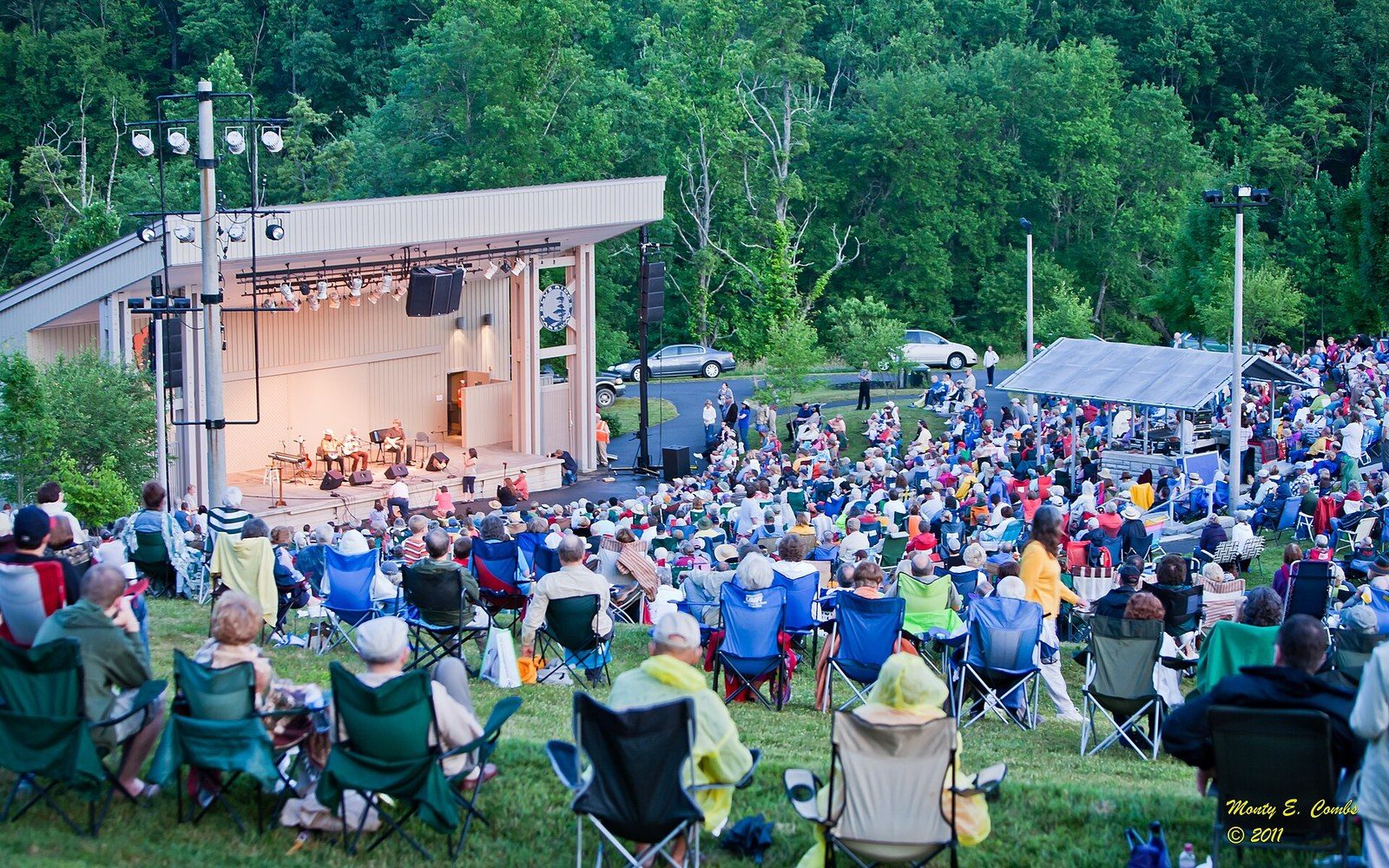
The amphitheatre at milepost 213, filled. The venue exists so the music stays audible from the road.
Photo: Blue Ridge Music Center Amphitheater Stage · Wikimedia CommonsWhat the field recordings fixed
When collectors came into the Blue Ridge counties in the 1920s and 1930s — some working for the Library of Congress, some independently — they recorded banjo players whose styles varied enormously by county and by family. The Archive of American Folk Song at the Library of Congress ↗ holds recordings from these sessions that capture not just the tunes but the idiosyncrasies of individual hands: how hard the thumb struck, how much melody a player pulled out of the brush stroke, whether the tunings ran to open D or open G. Those distinctions matter because they represent genuine regional variation within a tradition that outsiders often flattened into a single category.
What the recordings also fixed, unintentionally, was a moment in which the racial history of the instrument had already been substantially obscured. Most of the musicians documented in the Virginia and North Carolina mountains by the major collectors of that period were white. The Black banjo tradition in the same region was underrecorded, for reasons that followed from the social structures of the time rather than from any absence of players. Recent archival and oral-history work, including projects connected to institutions like the Smithsonian, has worked to recover that side of the ledger.

A reel-to-reel machine. Before tape, a performance nobody wrote down was not kept.
Photo: 2017 Magnetofon szpulowy Aria M 2408 SD · Wikimedia CommonsThe instrument on the road
The Blue Ridge Parkway passes through a band of counties in Virginia and North Carolina where clawhammer banjo remained an active practice long after it had faded elsewhere, and that continuity is part of why the Music Center at milepost 213 exists where it does. The Parkway's designers understood by the mid-twentieth century that the road was traversing living culture as well as scenic landscape, and the siting of the Music Center — in Galax, Virginia, close to one of the most sustained old-time music communities in the country — reflects that understanding.
The Galax area, anchored by the Old Fiddlers' Convention ↗ that has run since 1935, is one of the places where the clawhammer stroke was never treated as a revival or a reconstruction. It was simply the way banjo was played. The annual gathering there is not a museum exhibit; it is a competitive event with a living community of players, many of whom learned from parents and grandparents in direct succession.
What the Parkway offers, in its quiet way, is a route through the geography where that succession held. The road does not make the music, but it provides the frame — the milepost sequence, the designed views, the deliberate slowness — that lets a driver understand the landscape as a place with depth rather than a backdrop with scenery. The banjo's own depth runs in the same direction: further back, through more hands, across a wider Atlantic, than the mountain myth ever allowed.
More in Music