Music / The country it runs through
A venue built into the road
The Blue Ridge Music Center sits on the Parkway near milepost 213 and exists to keep the regional music audible on the road itself.
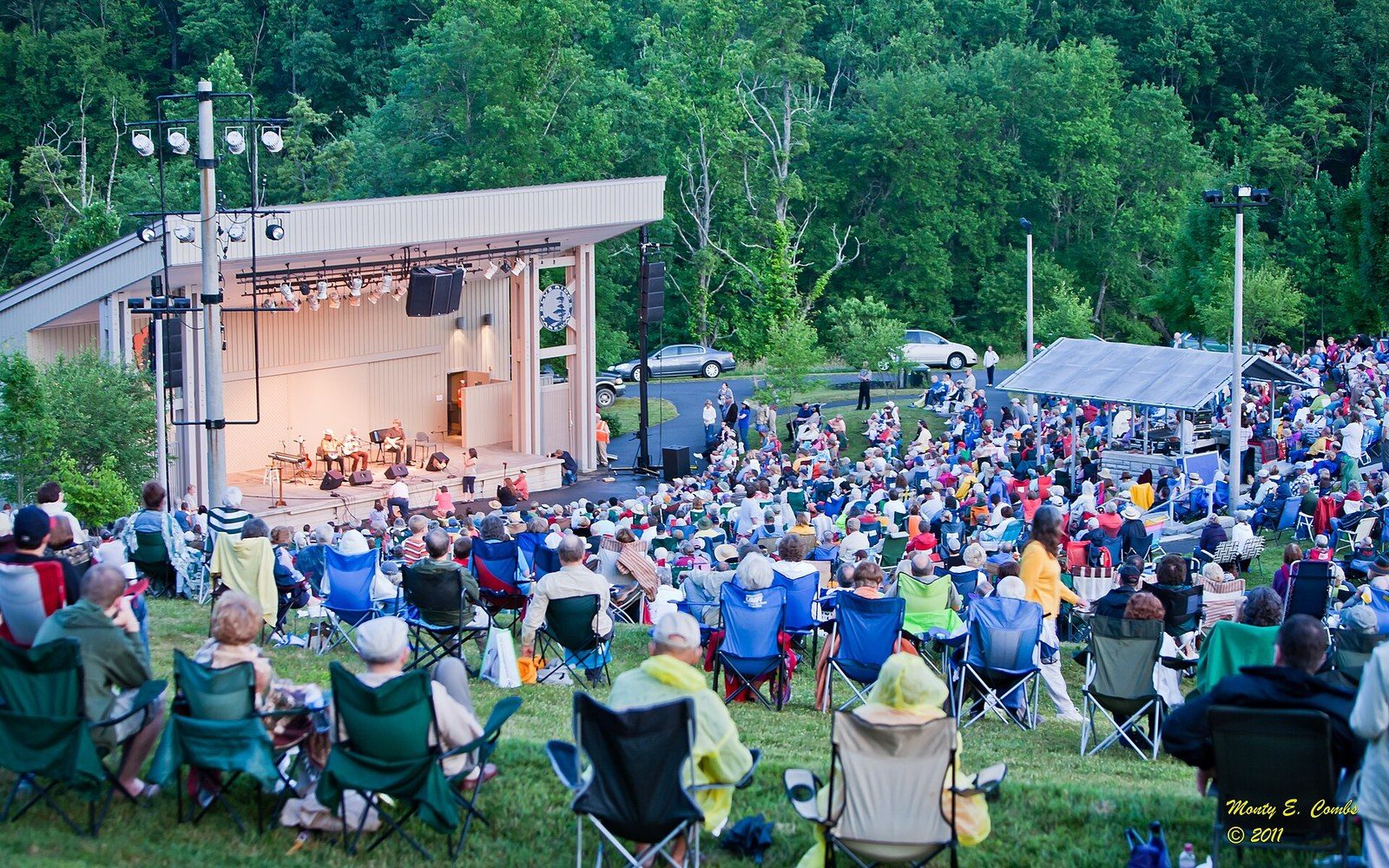
The amphitheatre at milepost 213, filled. The venue exists so the music stays audible from the road.
Photo: Blue Ridge Music Center Amphitheater Stage · Wikimedia CommonsThe Parkway gets a stage
The Blue Ridge Music Center occupies a grassy bowl at milepost 213, near Galax, Virginia — a town that has been central to old-time string-band music for long enough that its annual Old Fiddlers' Convention, running since 1935, is one of the oldest and most attended fiddle gatherings in the country. Placing a dedicated music venue here was not incidental. The site sits at the cultural headwaters of a tradition that runs straight through the communities below the ridge: fiddle tunes, clawhammer banjo, and the modal ballads that collectors found still alive in these coves in the early twentieth century.
The Music Center opened in 2001 as a joint venture between the National Park Service and the Blue Ridge Parkway Foundation, which raised private funds to match federal appropriations. The outdoor amphitheater — faced in native stone, following the Parkway's own material language — seats a large audience and is oriented so that the ridge forms its backdrop. An indoor interpretive center runs alongside it, holding instruments, photographs, and audio recordings that trace the regional tradition from its Scots-Irish and African American roots through to the commercial recordings that carried it out of the mountains in the 1920s and 1930s.
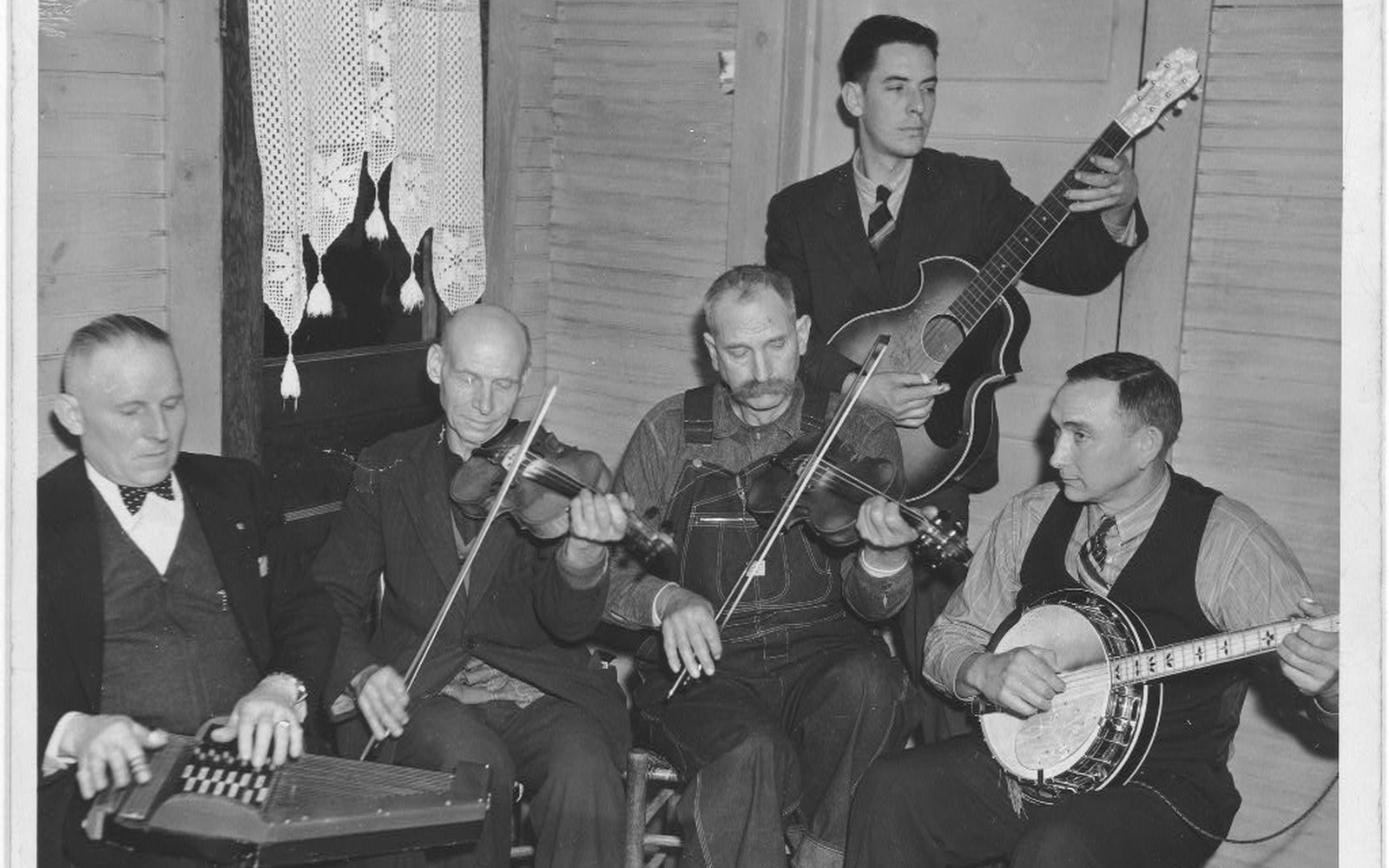
A Virginia string band in 1937. Zither, two fiddles, guitar and banjo — the instrumentation collectors kept finding.
Photo: Virginia-stringband-1937 · Wikimedia CommonsWhat the music actually is
The tradition the Center was built to document is not one thing. The southern Appalachian string-band repertoire is itself a confluence: English and Scottish ballad forms that survived in oral transmission long after they had dropped out of British practice; African American banjo technique that reshaped how the instrument was played across the region; and a body of fiddle tunes whose modal tunings still carry the sound of somewhere specific. The clawhammer style — a down-picking stroke that gives old-time banjo its distinctive snap — is the playing technique most closely associated with this geography, and it is distinct from the later three-finger bluegrass style that came out of the same region a generation later.
Galax itself gave its name to a particular sound. "The Galax sound" is a loose descriptor for a hard-driving, rhythmically aggressive style of old-time fiddling associated with the Carroll and Grayson County area. It was documented by field recorders — researchers who traveled into rural communities with portable recording equipment to capture performances that existed nowhere in written form — and some of those recordings from the 1920s and 1930s remain the earliest evidence of specific tunes and playing styles. The American Folklife Center at the Library of Congress ↗ holds substantial collections from this work, including material gathered in the Virginia and North Carolina mountains by figures including John Lomax and his collaborators.
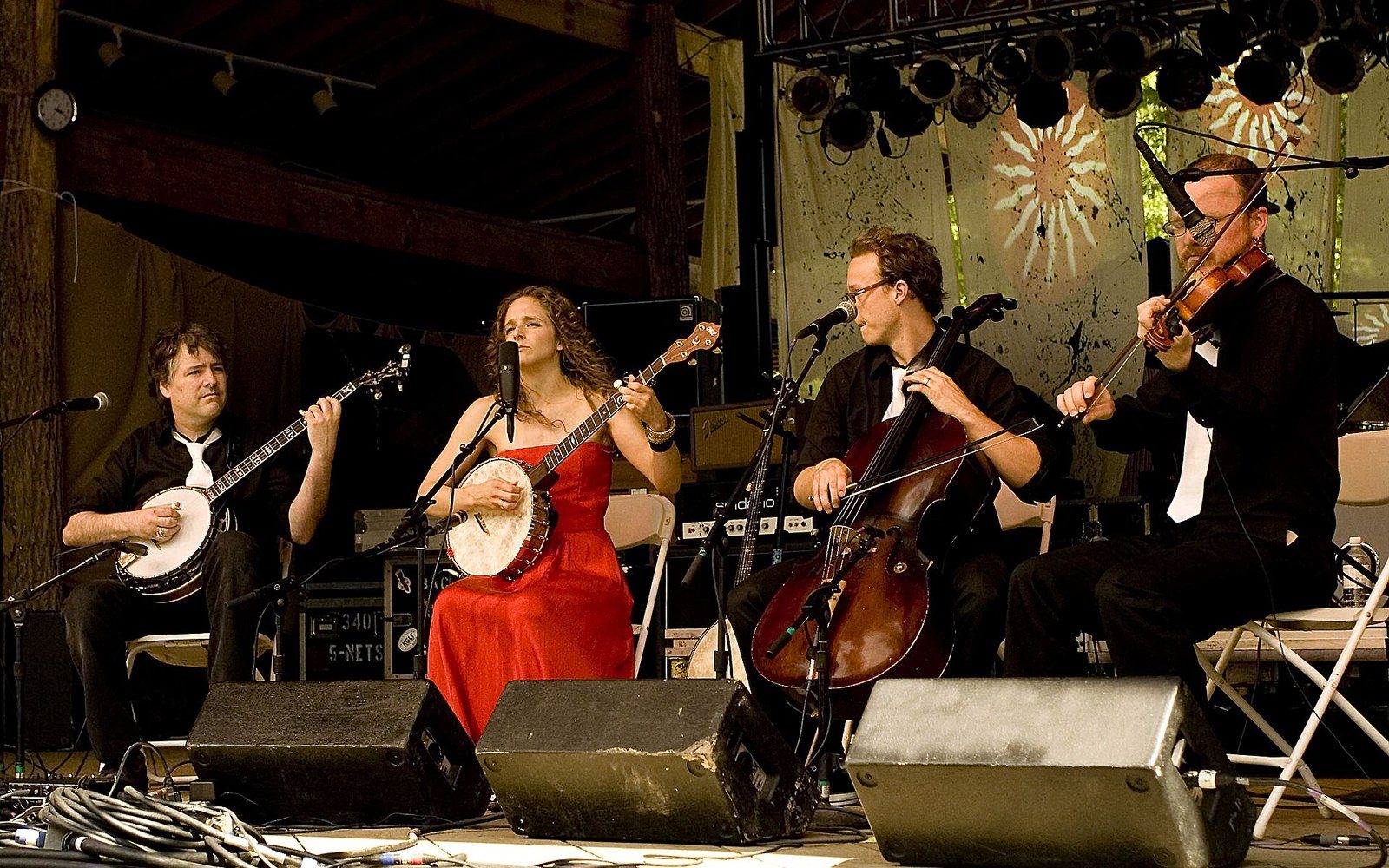
A banjo on stage. The clawhammer technique played in these mountains descends from African American practice.
Photo: Sparrowquartet · Wikimedia CommonsThe venue as design argument
That a music center appears at all on the Parkway is itself a design statement. The road was conceived as a through-route of experience, its stopping places calibrated to landscape, not commerce. Craft and cultural heritage were always part of the program — the preserved working mill at Mabry Mill, the folk-craft demonstrations at various waysides — but a functioning performance venue is a step further. It argues that the regional sound is as much a feature of the Blue Ridge as the heath balds or the stone culvert headwalls, and that the road is incomplete without it.
The amphitheater programming runs to live old-time and bluegrass performance, but the interpretive center makes the stronger case: that the music is not folk decoration but a documented, traceable tradition with specific instruments, specific players, and specific places of origin. The Smithsonian Folkways catalog ↗, which holds decades of field and studio recordings from the region, gives depth to what the Center presents physically.
Standing in that stone-rimmed bowl with the ridge behind you, it is possible to hear why the location matters. The Parkway runs through the same country where the music was made. The venue is not importing something from elsewhere and setting it on the road for effect. It is pointing, as clearly as a milepost points, at what was already here.
More in Music