Music / The country it runs through
Songs collected in these valleys
Collectors working in the southern Appalachians recorded ballad traditions with traceable British and Irish antecedents, and the collections are datable documents.
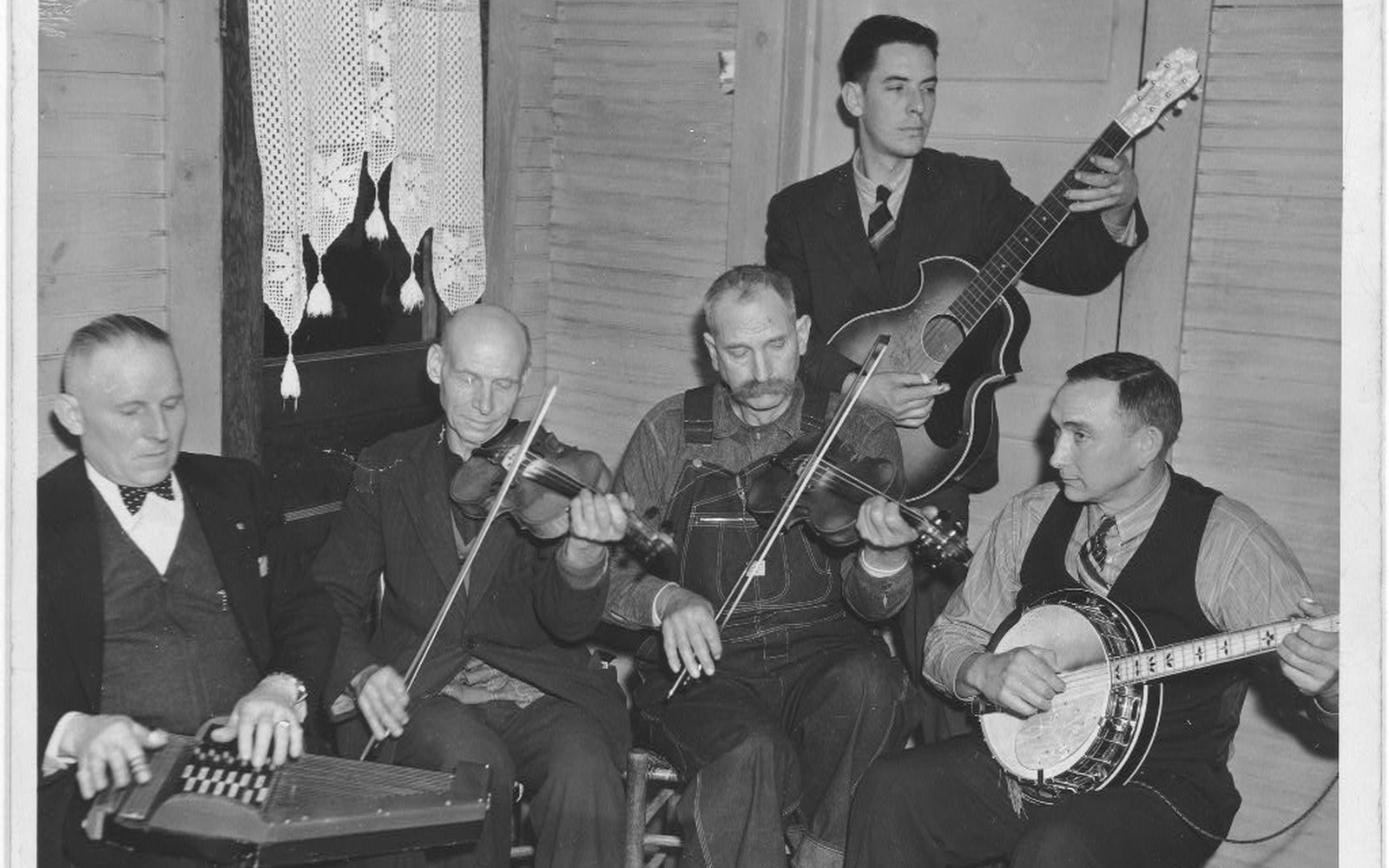
A Virginia string band in 1937. Zither, two fiddles, guitar and banjo — the instrumentation collectors kept finding.
Photo: Virginia-stringband-1937 · Wikimedia CommonsThe tradition that was still being sung
By the time paved roads reached the deepest hollows of the southern Appalachians, the ballad tradition that had been brought across the Atlantic was still alive in voices. This was not revival or reconstruction — the songs had simply continued, passed between generations without the interruption that industrialisation had imposed on the same repertoire in England and Ireland. When collectors arrived in the early decades of the twentieth century, they found a living archive.
The ballads they heard belonged recognisably to the canon that the English scholar Francis James Child had catalogued between 1882 and 1898 in his five-volume The English and Scottish Popular Ballads. Child had worked from manuscripts and printed sources; the Appalachian collectors worked from singers still breathing. The encounter between those two bodies of knowledge — one textual and historical, the other oral and contemporary — produced some of the most consequential field recordings in American musical history.
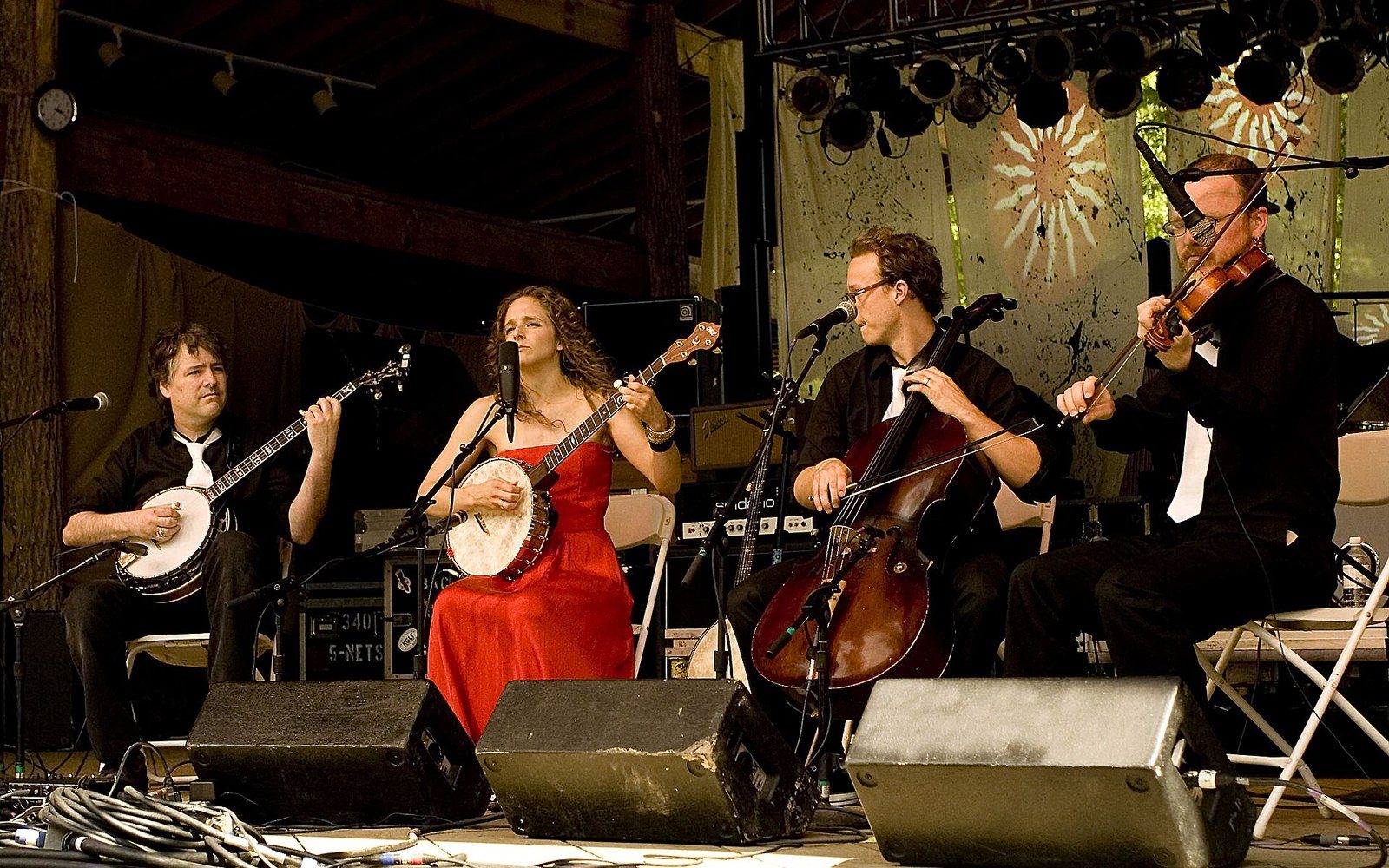
A banjo on stage. The clawhammer technique played in these mountains descends from African American practice.
Photo: Sparrowquartet · Wikimedia CommonsWhat the collectors found, and when
The decisive early figure was Cecil Sharp, an English folklorist who made three collecting trips to the southern mountains between 1916 and 1918, accompanied by his assistant Maud Karpeles. Sharp was already the leading force in the English folk-revival; what he found in the Appalachians confirmed and complicated what he had assumed. He collected more than five hundred songs and ballads from singers in Virginia, North Carolina, Kentucky and Tennessee, publishing the results in 1917 and 1932 under the title English Folk Songs from the Southern Appalachians. The songs Sharp transcribed — "Barbara Allen," "Lord Thomas and Fair Ellender," "The House Carpenter" — were versions of Child ballads, often closer in melodic shape to the oldest English and Scottish variants than to anything surviving in Britain at the same time. The mountains had been a form of preservation.
Karpeles continued the work after Sharp's death in 1924, returning to North America and eventually editing a revised edition of the collection. Her editorial care made the published texts usable as documents rather than curiosities. Each entry gives the singer's name, the county, and in many cases the year of collection: the kind of provenance that turns a transcription into evidence.
What Sharp and Karpeles caught in transcription, others captured on disc. Robert Winslow Gordon began collecting phonograph recordings in the region in the early 1920s, eventually forming the nucleus of what became the Archive of American Folk Song at the Library of Congress. The archive's holdings ↗ from the southern Appalachians are datable: a recording of a singer from Ashe County in 1927 is not an impression of the tradition but a document of a specific performance on a specific day. The singers are named; the locations are named. This is what separates the archive from the romantic generalisation that the mountains preserved something ancient and unspecified.
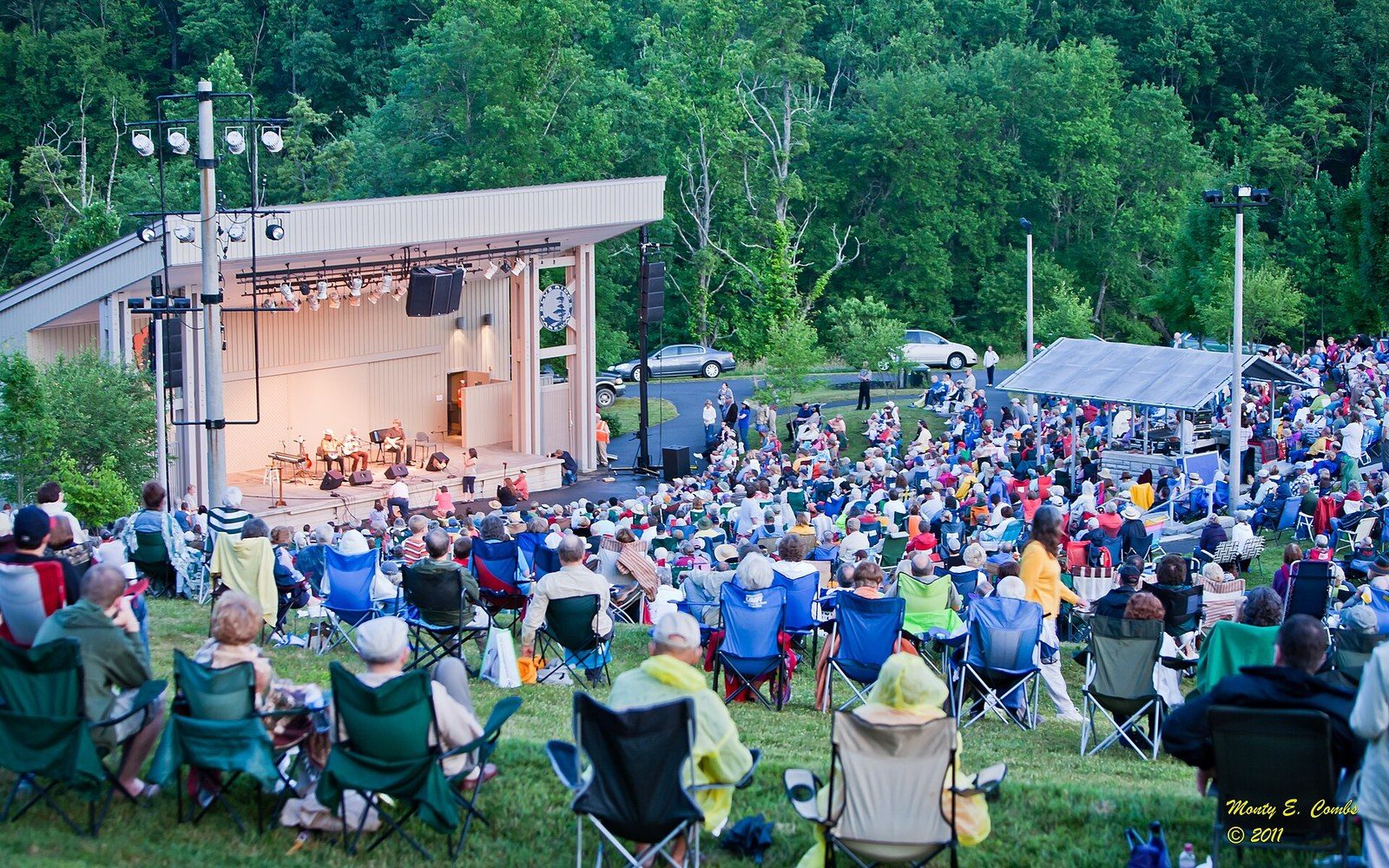
The amphitheatre at milepost 213, filled. The venue exists so the music stays audible from the road.
Photo: Blue Ridge Music Center Amphitheater Stage · Wikimedia Commons
A reel-to-reel machine. Before tape, a performance nobody wrote down was not kept.
Photo: 2017 Magnetofon szpulowy Aria M 2408 SD · Wikimedia CommonsJohn Lomax and his son Alan Lomax extended the archive's reach through the 1930s and 1940s, recording across the South including the mountain counties of Virginia and North Carolina that the Blue Ridge Parkway now runs through. Alan Lomax in particular understood the recordings as cultural argument as much as documentation: evidence that a musical tradition of real antiquity and complexity existed in these communities. His later theoretical writing on cantometrics — a cross-cultural method for comparing singing styles — rested partly on the mountain material.
Dry-laid stone at the Humpback Rocks farm museum. Parkway masonry was specified to look older than the road it belongs to.
Photo: BLRI 58-JB-1055 · Wikimedia CommonsThe tune families and their traceable origins
The songs Sharp collected in the valleys and coves along what is now the Parkway corridor were not random survivals. They clustered in identifiable tune families that musicologists have traced across the Atlantic. "Barbara Allen," perhaps the single most widely collected ballad in North America, appears in British records from at least the seventeenth century — Samuel Pepys noted hearing it sung in 1666 — and the Appalachian versions collected by Sharp and others show the kind of melodic variation that comes from oral transmission over generations: the architecture of the tune survives while the ornaments shift with each singer.
The Scottish and Irish contributions to the tradition were as significant as the English. Settlers from Ulster and the Scottish Lowlands brought pentatonic scales and a style of unaccompanied or minimally accompanied singing that shaped the Appalachian sound as much as any English inheritance. By the time recording technology arrived, the strands had been woven together for a century or more, and disentangling them requires exactly the kind of dated comparative evidence that the early collectors produced.
Instrumental music was collected alongside the ballads. The fiddle traditions of the Virginia and North Carolina mountains have documented antecedents in Scottish and Irish dance music, filtered through two centuries of American adaptation. Clawhammer banjo — a downstroke frailing technique distinct from the finger-picked styles that would later dominate — was already present in the mountains when the first collectors arrived, and its own history reaches back through African American musical practice, a lineage the earliest collectors were not always careful to acknowledge. Later scholarship has been more precise on this point, tracing the banjo's construction and playing style to West African antecedents carried into the mountains through contact and exchange rather than isolation.
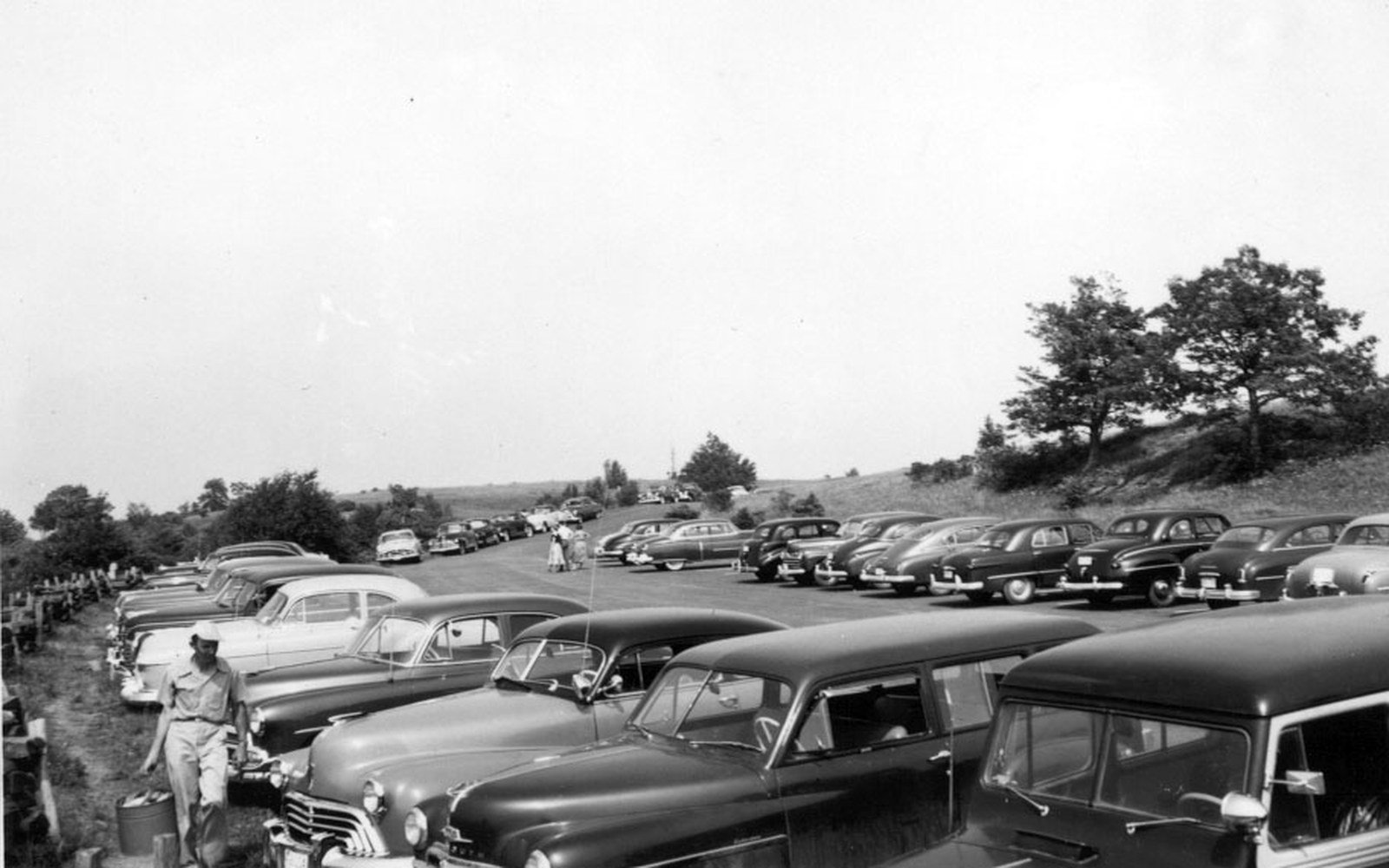
The Bluffs, in Doughton Park. Nothing may be sold within sight of this shoulder.
Photo: Parking Lot at Bluffs Picnic Area (22dd3275-b2b6-d95e-3fad-798bd175b0c8) · Wikimedia CommonsWhy the dates matter
The collections are useful precisely because they are dated. When a singer recorded by Maud Karpeles in Madison County, North Carolina, in 1950 performs a version of "The Two Sisters" that matches a Scottish broadside from the 1680s in its narrative structure but diverges entirely in melody, that divergence is data. It shows what oral transmission does over time and distance. It also shows what was still being sung in the southern Appalachians within living memory of people who are alive today.
The Blue Ridge Parkway was itself a product of the same Depression-era period that gave the Lomax recordings their urgency. The road was begun in 1935; the Archive of American Folk Song had been established at the Library of Congress in 1928. Both projects ran through the same landscape at roughly the same moment, one carving a route through the ridge while the other transcribed what was being sung in the valleys below. The coincidence is not incidental. Both were federal projects that understood the southern Appalachians as a place whose particularity was worth preserving, and both left records — one in asphalt and stone, one on acetate discs and paper — that are still consulted now.
The Blue Ridge Music Center near milepost 213 in Virginia holds some of this history in institutional form, but the evidence that most repays attention is in the archive itself: a named singer, a named county, a year, a song that someone else had written down three hundred years before in a different country, still being sung.
More in Music